I Want to Design a Art for T Shirt Third Second First Class Navy Crow

1917 recruiting affiche for the United States Navy by Howard Chandler Christy, featuring a woman wearing the most widely recognized uniform, the enlisted clothes blues.
The uniforms of the Usa Navy include wearing apparel uniforms, daily service uniforms, working uniforms, and uniforms for special situations, which have varied throughout the history of the navy. For simplicity in this commodity, officers refers to both commissioned officers and warrant officers.
Dress uniforms [edit]
The United states of america Navy has three categories of dress uniforms, from least to most formal: service, full, and dinner dress.
Service dress [edit]
Service dress uniforms are worn for official functions non ascent to the level of full or dinner wearing apparel. They are likewise commonly worn when traveling in official capacity, or when reporting to a command. The civilian equivalent is a concern suit. Service Dress Bluish may be worn year-round, while Service Wearing apparel White is reserved for summertime or tropical zones. Ribbons are worn over the left chest pocket in all variations of the service dress uniform. An all-weather condition overcoat or reefer coat may be worn with service dress uniforms in cold or choppy atmospheric condition.
Officers and chief petty officers [edit]
Service Wearing apparel Blue [edit]

An officeholder inspects enlisted sailors in Service Dress Bluish (2008)

A female U.Due south. Navy officer in Service Dress Blue uniform (2012)
The Service Dress Blue (SDB) uniform consists of a dark navy bluish conform coat and trousers (or optional skirt for women) that are nearly blackness in color, a white shirt, and a black iv-in-mitt tie for men or a cervix tab for women. The material is generally wool or a wool blend, depending on the vendor. The men's jacket is double-breasted with 6 gold-colored buttons, and the women's jacket single breasted with a single row of four gold-colored buttons. Rank insignia are gold sleeve stripes for deputed officers, while rating badges and service stripes are worn on the left sleeve by chief petty officers (CPOs). The prescribed headgear is a white combination cap, although a navy blue garrison cap is optional in some situations when the jacket is not worn, unless stated otherwise past the prescribing potency. Offset in 2016, the Navy began phasing out the distinct female person combination cap and at present prescribes a cover like to the male version for female officers and CPOs; the prior female versions were authorized for wear until October 2018.[1] Commissioned and warrant officers in a higher place grade W-ii wear a cap badge of the U.S. shield and hawkeye in silvery upon gold crossed anchors, warrant officers at grade Westward-1 a pair of crossed anchors, while CPOs wear a single fouled ballast. The combination cover'southward chinstrap is gold for commissioned and warrant officers, narrower gold for midshipmen and warrant officers 1, and black for CPOs. Females typically wear beltless slacks with the SDB, although since January 2017, belted slacks tin be worn as an alternative.[two]
Service Dress White [edit]
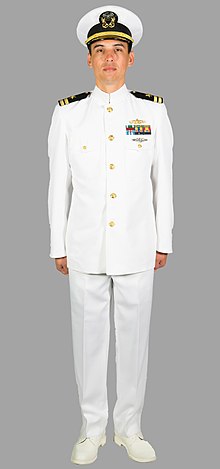
A lieutenant models the Service Wearing apparel White uniform (2015)
The Service Apparel White uniform had until recently been dissimilar for the men'south and women'southward variations. Men wear a high stand up-collared white tunic, with shoulder boards for officers or metal anchor collar devices for CPOs, white trousers, and white shoes. This uniform is informally called "chokers" due to the standing collar. The textile, formerly cotton wool, today is a weave of polyester known as "Certified Navy Twill". The white combination cap is the prescribed headgear.[iii]
Women previously wore a uniform similar to the Service Clothes Blue uniform merely with a white coat and skirt or trousers. Officer's rank insignia consisted of lacing on the sleeves in the same mode equally on the blueish uniform, while CPOs wore rank insignia pins on the lapels of the jacket. However, the Navy announced female uniform changes to resemble the men's uniforms, and female officers and CPOs began wearing stand-collared tunics like to the male uniform in early 2017, with full replacement of the old-fashion uniform by the stop of Jan 2020 (delayed from an initial appointment of December 2019).[iv]
Junior enlisted sailors [edit]
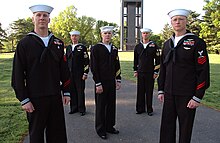
Petty officers in 2006 wearing service dress blue uniforms displaying both cherry-red and gold rating badges and service stripes.
Service Wearing apparel Blues for male person junior enlisted sailors are based on the archetype sailor conform in navy blue, colloquially referred to as "crackerjacks" because of the crewman-suited figure that adorns the packaging of Cracker Jack snacks. They consist of a navy blue wool pullover jumper with a tar-flap collar adorned with three rows of white stripes on the collar and cuffs and two white stars, 1 at each corner of the collar. A black silk or constructed fiber neckerchief, rolled diagonally, is worn around the neck, under the collar, with the ends tied in a foursquare knot in the center of the chest. The trousers for the uniform are flared as "bell bottoms". The trousers have traditionally featured a broad-fall opening, though changes to the trouser announced in 2012 have added a zippered fly, rendering the buttons just decorative.[v] A traditional white "Dixie cup" hat is likewise worn, as well as black leather shoes. For a brief menstruation in the 1970s and early 1980s, male enlisted sailors in paygrades E-1 to East-six wore a double-breasted blue uniform based on the version worn by officers and CPOs, but with greyness buttons and a combination cover with an emblem consisting of a silver eagle and the letters "USN".[6]

The female inferior enlisted sailors' Service Apparel Blue uniform was formerly similar to the short-lived male compatible from the 1970s.[seven] [8] This uniform was phased out and was replaced by a female person-cutting variant of the "crackerjacks" with the transition begun in Oct 2016 and completed past the stop of January 2020 (delayed from its initial date of December 2019).[4] [ix] [x]
Until 2016, the junior enlisted Service Dress White compatible, for both sexes, consisted of a white jumper with obviously collar, white bong-bottom trousers with a fly front (or optional skirt for women), black leather shoes, the black neckerchief worn in the same way equally with the Service Apparel Blue uniform. Males wore the white "Dixie loving cup" cap, while females wore the aforementioned cap as their Service Wearing apparel Blue uniforms. That Service Apparel White jumper was actually derived from the former Undress White, with its broad gage-less sleeves and no piping. However, commencement in October 2015, Service Dress White jumpers were changed to feature navy bluish piping on cuffed sleeves, stars and navy blue piping on the neckband, and a yoke, making information technology a 'photo-negative' of the Service Dress Bluish jumper.[11]
Ribbons are worn with these uniforms over the top left pocket opening, along with qualification or warfare insignia. Either the all-weather coat or peacoat may be worn with this uniform in common cold or inclement weather. The color of the enlisted rate insignia and service stripes for the Service Dress Blues is either red or gilded based upon how many years the wearer has served (prior to 2019 information technology was contingent on disciplinary history); the colors on the Service Dress Whites are ever black.
Full dress [edit]
Full Clothes uniforms are worn for ceremonies such as changes of command, retirements, commissionings and decommissionings, funerals, weddings, or when otherwise advisable. Full Dress is similar to Service Dress except that instead of ribbons, full-size medals are worn in a higher place the left breast pocket, with ribbons worn on the opposite side for decorations without corresponding medals. Swords or cutlasses are authorized for article of clothing past officers and master petty officers,[12] and may be required for Lt. Commander and above.
For the Ceremonial Guard in Washington, D.C., the inferior enlisted Full Apparel uniforms are further modified with the wearing of a white pistol chugalug, ascot, and wearing apparel aiguilette (the latter two are white for winter and navy blue for summertime), and white sheet leggings. Other honor guards are only authorized leggings and white pistol belt.
-
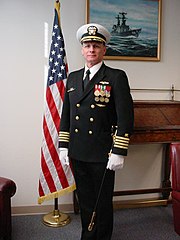
A navy captain's "Full Wearing apparel Blueish Compatible" with full-sized medals, white gloves and sword (2007)
-
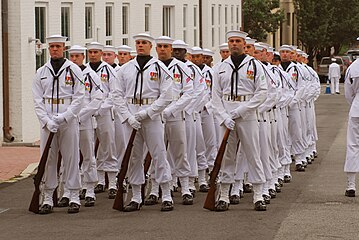
Enlisted Full Dress Whites worn at a Modify of Command Anniversary in 2009. This is the older-way version that is due to be replaced in 2021; it lacks the blueish pipage and stars
Dinner dress [edit]

A Navy officer in blueish mess dress (2017)
The dinner apparel uniforms of the United states Navy are the most formal and have the most variations. For officers, at that place are Dinner Dress Blue and Dinner Dress White, Dinner Dress Blue Jacket and Dinner Wearing apparel White Jacket, and Formal Dress. Although trousers are authorized, women frequently wear the appropriate colour brim.
Dinner Dress Blueish and White are identical to their Service Dress versions, only worn with miniature medals and badges with no ribbons. Dinner Clothes Bluish is additionally worn with a dress shirt and black bow necktie. These variants are unremarkably worn by many junior officers and enlisted personnel equally substitutes for the more formal Dinner Dress Jacket variant which is only prescribable for Lieutenant Commander and to a higher place and optional for Lieutenant and beneath.
The Dinner Dress Blue/White Jacket uniforms feature a short mess jacket with iii buttons on either side, worn open with a black bow tie and gilt cummerbund (women substitute a cervix tab for the bow tie). Male officers bear witness rank stripes on the sleeves of the jacket for the bluish version and on shoulder boards for the white version, while women officers only wear sleeve stripes. This compatible is equivalent to black tie in usage.
The Formal Dress variation is the most formal, and is identical to the Dinner Apparel Blue Jacket uniform but worn with a white waistcoat with gold buttons in identify of the cummerbund, a white bow tie, and matching mother-of-pearl studs and cuff links. Though rarely used, men can also substitute a tailcoat for the standard dinner clothes jacket with this uniform. The female version is substantially the aforementioned as Dinner Dress Blue Jacket, but substitutes the mother-of-pearl studs and gage links for gold. This uniform is equivalent to white tie in usage. Additionally, this compatible is only prescribed for chiefs and officers.
Headgear is not required for dinner clothes uniforms unless an outer jacket is worn.
Those holding the rank of lieutenant and beneath take the option of using the Dinner Apparel uniform when Dinner Dress Jacket is prescribed. The enlisted sailors who are main niggling officer and above article of clothing a uniform similar to the officers, but with rank insignia and service stripes on the left sleeve. While enlisted who are petty officer first grade and below have optional Dinner Wearing apparel Jacket uniforms similar to the officers and chiefs, they may also vesture their Dinner Clothes uniform, which is the traditional Service Clothes "sailor adapt", with miniature medals instead of ribbons.
Service uniforms [edit]
Service uniforms are the U.S. Navy's daily wearable uniforms, and exist in several variations. They are intended for use in office environments, in positions that interact with the public, and in sentry situations. Skirts are authorized for women in all service uniforms.
Officers and chief petty officers [edit]
Service Khaki [edit]

U.Southward. Navy chief petty officers wearing the Service Khaki uniforms with the former female "bucket-styled" combination covers in September 2006.
The Navy get-go authorized a khaki uniform in 1913 as a applied garment for early naval aviators; they were given permission to article of clothing Marine Corps khaki uniforms with naval insignia when flying or working on shipping.[13] Khakis were authorized aboard submarines in 1931 and as an officeholder's working uniform on all ships in 1941.
The Service Khaki uniform today is reserved for officers and enlisted sailors at principal petty officeholder and to a higher place. It is a brusque-sleeved khaki button-upwardly shirt and matching trousers, worn with a golden chugalug buckle. The shirt features two forepart flap pockets and an open up collar. Ribbons are worn above the left pocket of the shirt, with the warfare insignia above them. A nametag may exist worn above the correct pocket, and rank insignia is worn on the neckband. The regulations for ribbons state the highest three awards, or all ribbons tin be worn at once. Headgear consists of either a combination cap with a khaki embrace or a khaki garrison cap.[14] Currently black and chocolate-brown oxford shoes are authorized for all officers and CPOs,[xv] though traditionally brown shoes are worn but by aviators. Females are authorized to article of clothing the same over-blouse as junior enlisted sailors. The compatible is also worn by cadet officers and buck chief petty officers in the Navy Inferior ROTC.[16]
Summer White Service [edit]
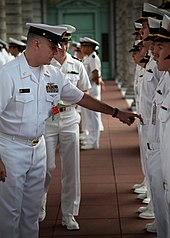
U.S. Naval University Midshipman being inspected wearing Summertime Whites (2010)
The Summer White Service uniform (formerly known as Tropical White Long and nicknamed the "milkman" and "Good Sense of humor" uniform) consists of a short-sleeved, open-collared white button-upwards shirt, white trousers and belt, and white dress shoes. Authorized headwear is the combination cap. Officers wear shoulder boards with this uniform, while chiefs wear metal collar insignia. The women's shirt for all ranks has shoulder straps, but conduct nothing except for shoulder boards worn by officers. Like Service Khakis, Summer Whites are available in several materials (poly/cotton and Certified Navy Twill). When assigned every bit the Uniform of the Twenty-four hours, a Plan of the Twenty-four hour period/Plan of the week volition state "Summer White." Either the All-Weather Coat, Blue jacket, or Peacoat may exist worn with this uniform. While once authorized for inferior enlisted, it is now restricted to officers and chiefs. Members E-6 and below previously wore a short-sleeved Summer White compatible with rate insignia on the left sleeve, only the uniform was discontinued by the Navy in December 2010.
Junior enlisted [edit]

The Navy Service Compatible for junior enlisted sailors (2008)
[edit]
The U.Due south. Navy underwent a comprehensive review of every uniform from 2004 through 2007, intending to supersede the different working uniform for all hands and the seasonal service uniforms with a single twelvemonth-circular service uniform for junior enlisted personnel below chief little officer. The Navy Service Uniform has replaced the Winter Blue Uniform and Summer White Compatible (both discussed below), which were phased out on 31 December 2010 when the rollout of the new service compatible was completed. Enlisted personnel at present accept a single Service Uniform. Navy Junior ROTC units likewise received this new compatible, where, unlike in the U.S. Navy proper, it is worn by both cadet officers and enlisted cadets.
The Navy Service Uniform is a twelvemonth-round service uniform to withstand day-to-24-hour interval classroom and office-like environments where the service compatible is typically worn. It consists of a short-sleeve khaki shirt for males and a khaki weskit-style blouse for females, fabricated from a wash and clothing 75% polyester, 25% wool alloy, with permanent military creases, black trousers for males with beltless slacks for females and optional beltless brim, and a blackness unisex garrison cap. Silverish anodized-metallic rank insignia is worn on shirt/blouse collars and cap. The service uniform as well includes a black relaxed-fit jacket with a knit stand-upward collar and epaulets, on which petty officers clothing large, silver anodized-metal rate insignia.
Working uniforms [edit]
Working uniforms are described by the navy as being worn when other uniforms may become unduly soiled or are otherwise inappropriate for the task at hand. These are worn at sea and in industrial environments aground. In July 2010, the Navy Working Uniform and coveralls became the only authorized working uniforms. V-neck sweaters were authorized with coveralls until 2015.[17]
[edit]

A female officeholder wearing the NWU Type 3 in AOR-2 (2016)

A digitized rendition of a swatch of AOR-2, the camouflage pattern used on the NWU Blazon III.

A digitized rendition of a swatch of AOR-one, the camouflage pattern used on the NWU Type II.
The Navy Working Uniform (NWU) is a utility uniform with multiple pockets on the shirt and trousers. Iii versions of the compatible exist, each with a multi-color digital camouflage print pattern similar to those introduced by other services. Type I is predominantly blue with some grey for the majority of sailors. It was originally developed for shipboard use, but proved unsuitable for shipboard environments and was discontinued in 2019. Type Two is a desert digital pattern currently restricted to SEALs and other sailors such equally Seabees assigned to Naval Special Warfare Units when in desert environments. Blazon Iii is a woodland digital pattern for sailors in shore commands and riverine units. The cover-up patterns are like to the MARPAT worn on the Marine Corps Combat Utility Uniform by U.S. Marines.
The colors of the NWU Type I, co-ordinate to the U.South. Navy, were intended to reflect the navy's heritage and connectedness to seaborne operations,[18] while hiding wearable and stains, something unavoidable with the utilities and working khakis used previously.[nineteen] The colors were chosen to match the near commonly used paint colors aboard ship, extending the lifetime of the compatible on long deployments where uniforms often come into contact with freshly painted surfaces. An anchor, USS Constitution, and eagle (ACE) emblem is embroidered on the left breast pocket on all Type I NWUs. Accessories included a navy blue cotton fiber T-shirt, an eight-bespeak utility encompass, and a web belt with airtight buckle. The compatible was worn with rank insignia on both collar points and on the front panel of the utility cover, with sew-on name and "U.South. NAVY" tapes, too on the new digital background design, having gilt-colored lettering for officers, CPOs and midshipmen. All ranks below CPO wore argent-lettered name tapes. The NWU Type I was phased into service beginning in January 2009.,[20] merely was phased out as of ane Oct 2019.
The Type II and Three patterns are overall darker than their respective MARPAT progenitors, modified with dissimilar colour shades and a vertically-aligned pixel pattern for the woodland version (compared to the horizontal alignment of woodland MARPAT).[21] The additional patterns addressed the fact that the bluish and gray Type I pattern was non meant for a tactical environment.[22] Rank insignia is embroidered and worn on a tab in the center of the torso, proper name and "U.S. Navy" taps are embroidered in brown (Type II) or black (Type III). Backlash from Marines, including an objection from Commandant Conway, led to restrictions when habiliment regulations were released in 2010.[23] The Blazon II is restricted for habiliment to Naval Special Warfare personnel, while Blazon Three was restricted to Navy footing units until tardily 2016.[24] The ACE keepsake is omitted from the NWU Blazon II and NWU Blazon Iii.
The uniforms are primarily composed of a 50/50 nylon and cotton blend, which eliminates the need for a "starch and press" advent and reduces the possibility of snags and tears from sharp objects (thus making the garment last longer). All the same this blend combines high flammability with the strength to hold onto the sailor's body while burning.[25] [26]
In Baronial 2016 the U.Due south. Navy announced that it is eliminating the NWU Type I in favor of the Type Iii which was phased in by 1 October 2019 for clothing as the standard working compatible ashore for all Navy personnel.[27] [28] Type Three will begin being issued to new navy recruits in October 2017. The Type 2 will remain restricted to vesture past Naval Special Warfare sailors when in desert environments. The Navy's goal of developing a single working uniform for wear aboard ship and ashore and past all ranks and rates which the NWU Type I was supposed to fulfill was never realized by the Type I. Shortly after its introduction it was establish to be unsuitable for shipboard wear because of its lack of flame resistance and so was banned from vesture aboard send (except for when in port) thus making it essentially a uniform to be worn while ashore only. Equally a uniform for wear ashore only, a design designed to conceal stains aboard ships is not nearly as constructive at concealment as a design designed to muffle people on land, thus the IIIs are used ashore. The Navy continues to work to develop a new shipboard working uniform.
While Navy uniforms traditionally take featured an indication of rank on the cover, the Type III uniforms have been designated to replace the rank insignia with the Anchor, Constitution, and Eagle (ACE) insignia per guidance that "The design of the eight-point utility cap is scheduled for a design change that will replace the rank device with the ACE logo" [29]
All-weather garments include a unisex pullover sweater, a fleece jacket, and a parka, all of which are available in matching camouflage patterns.[30] Beginning in 2016 the Navy had planned to also issue a lightweight version of the NWU Type I more suitable to hot environments.[one]
Blackness condom boots, identical to those worn by United States Coast Guard personnel with their Operational Clothes Uniform, are worn with the NWU Type I. Brown or tan boots tin exist authorized for wear with the Type II and III, though black is the standard color for sailors located in the contiguous United States. Boots come in two versions: black smooth leather boots, and blackness suede no-smoothen boots for optional wear while assigned to not-shipboard commands.
Shipboard Working Uniform [edit]

A navy seaman wearing flame-resistant "FRV" coveralls in 2015.

A navy quartermaster in 2014 wearing poly/cotton coveralls. The poly/cotton coveralls accept largely been replaced by the flame-resistant variant, though it is still authorized for wear by the navy.
The U.Southward. Navy issued a new model coverall for use equally a shipboard working uniform beginning in early on 2014. The new flame resistant variant (FRV) coverall is used aboard all ships. Information technology has largely replaced for shipboard use polyester cotton wool blend coveralls that provided inadequate fire protection and the NWU Type I for the aforementioned reason. The all cotton fiber FRVs are nighttime blue in color compared to the older coveralls, which are lighter.[31] [32] They employ rectangular velcro-backed nametags similar to those worn on flight crew suits, rather than the nametapes of the previous coverall.
U.S. Fleet Forces Command (FFC) continues a multi-phase wearable examination of improved flame resistant variant (IFRV) working compatible components for shipboard wear. FFC nigh recently conducted in-depth focus groups with fleet sailors aimed at refining the design of the IFRV coverall.[33] The IFRV coverall was approved for effect on 17 January 2017. Boosted feedback from the focus groups, later validated by a senior level working group, resulted in the preliminary design of a more professional looking two-piece utility shipboard uniform that tin can be worn both at sea and operational back up jobs aground. Habiliment tests of the paradigm two-piece variants are expected to occur in 2017.[34] [35]
Coats [edit]
All enlisted sailors may wear the navy bluish pea glaze, with a rate insignia on the left sleeve for petty officer 3rd class and higher, a navy blue "All Weather Coat" with rate insignia worn on the collar, or a navy bluish Working Uniform Jacket with rate insignia worn on the neckband.
Officers and principal petty officers may wear the calf-length wool "bridge glaze" or waist-length reefer, with gold buttons and rank insignia worn on the shoulder boards, or the all-weather coat, with rank insignia also worn on the shoulder or collar, depending on rank.
All sailors are authorized to wear the "Eisenhower" jacket with short-sleeved service uniforms with appropriate rank devices on the shoulder boards. The "Eisenhower" jacket is a waist length, black jacket with knit cuffs, and is named for its association with Dwight D. Eisenhower. The khaki windbreaker, previously authorized just with the service khaki uniform, was discontinued on 30 September 2016.
Naval aviators, naval flying officers, naval flight surgeons, naval aviation physiologists, and naval aircrewmen are authorized to wear G-1 seal-brown goatskin-leather flight jackets, with warfare insignia listed on a name-tag (rank optional) over the left breast pocket, either permanently stitched to the leather or attached with a Velcro claw-and-loop fastener. These jackets were previously adorned with various "mission patches," which signal places the wearer has served. Today, patches on the Yard-ane are limited to a maximum of three in addition to the name-tag, i.eastward., a unit insignia on the right chest pocket, an shipping type insignia on the correct sleeve and an aircraft type insignia or embroidered U.S. flag on the left sleeve.
Also, the Navy issues foul-atmospheric condition or cold-weather jackets as appropriate for the environment, which are generally olive or Navy blue in colour. These jackets are considered "Organizational Clothing". They do non belong to the sailor, and are not allowed for wearable off of the ship unless working in the most vicinity of a send.
Special uniform situations [edit]
[edit]
All enlisted members of the U.S. Navy Band, Washington, D.C. and the U.S. Naval Academy Band, regardless of rate, wear primary petty officer-style wearing apparel uniforms (i.e. Service and Full Dress Blues and Whites and Dinner Dress).[36]
[edit]

Corpsman wearing the Marine Corps Service Compatible in 2007.
As the Marine Corps does not have medical personnel, chaplains, and certain lawyers and divers, the Navy provides them.[a] These officers and enlisted of the Fleet Marine Forcefulness include doctors, dentists, nurses, hospital corpsmen, medical service sailors, chaplains, religious program specialists, Naval Gunfire Liaison Officers, defined, lawyers, legalmen, and Naval Academy midshipmen who are selected for marine officership. Considering of this relationship, these personnel are authorized to wear U.S. Marine Corps utility (desert/woodland) uniforms with Navy rank insignia replacing the Marine insignia for enlisted personnel (Navy and Marine officer rank insignia are identical) and with a "U.Southward. Navy" patch replacing the "U.S. Marines" one. They wearable the viii-point utility embrace, but it lacks the Marine Corps emblem. Additionally, Navy personnel attached to Marine units can elect to wear Marine service uniforms, with Navy insignia. Those opting to wear Marine Corps service uniforms must meet Marine Corps grooming and physical advent standards, which are more than stringent than Navy standards. This does non apply to the MARPAT uniforms, as this uniform is required for wear in the field when attached to Marine units, regardless of adherence to Marine Corps grooming standards. Navy personnel are not authorized to habiliment the Marine Corps Apparel Blue Uniform; instead Navy Dress Blue and White uniforms are worn.[37]
Other wear of combat utilities [edit]

Navy Rank and Markings on Regular army ACU
In add-on to Marine Corps detachments, combat utilities are too worn by Navy SEAL teams, along with SWCC crews who conduct clandestine maritime operations including supporting SEAL platoons and SOF cells. The Combat Utility Uniform (CUU) is authorized for those in the Explosive Ordnance Disposal (EOD) and Fleet Diver communities. Combat utilities are also authorized for those fastened to the Naval Construction Strength (NCF) (Seabee), Navy's Expeditionary Logistics Group, or the Navy's Expeditionary Gainsay Command (NECC). Likewise, Navy personnel assigned to some joint headquarters units, like Central Control in Qatar and Iraq, wearable Desert Utility Uniforms (DUU). Navy personnel such as Private Augmentees, Gainsay Camera Groups, Detainee OPS, and some in the special warfare community accept been wearing the Army'south ACU (Army Combat Uniform) when working closely with or attached to Regular army commands.[38]
[edit]
Aviators, Naval Flying Officers, and Naval Aircrewmen are authorized to clothing green or desert flight suits (made of nomex for fire protection), with rank insignia for officers stitched on the shoulders, and a proper name tag/warfare insignia on the left breast pocket. Either a Control/Navy ballcap or a Khaki Garrison Cap (for Deputed Officers and CPOs) are worn with this uniform. Green flight suits are the standard wearable; however, wing commanders may authorize desert flight suits for personnel located in hot climates. As of 2012, flight suits may now be worn off base in the same manner as the Navy Working Uniform.
Coveralls are authorized to exist worn with either the all-weather coat or utility jacket (for petty officers only).
Flying deck [edit]
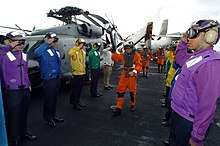
Flightdeck personnel on board an shipping carrier wearing unlike colored jerseys, denoting a specific function. (U.S. Navy) (2004)
Flight deck crew vesture colored jerseys which distinguish each personnel's role by sight.[39]
| Colour | Job |
|---|---|
| Xanthous |
|
| Green |
|
| Carmine |
|
| Imperial |
|
| Blue |
|
| Brown |
|
| White |
|
USS Constitution [edit]
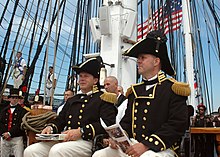
Officers and coiffure of USS Constitution (2005)
The ship USSConstitution is the oldest commissioned ship in the U.Due south. Navy, the only ane of the six original United states frigates still in beingness. Constitution is presented to the public as the transport appeared during the War of 1812, and personnel stationed aboard Constitution still wear uniforms co-ordinate to regulations posted in 1813. These uniforms are worn on ceremonial occasions, such as the annual turn-effectually cruise in Boston every Independence Solar day.[43]
[edit]
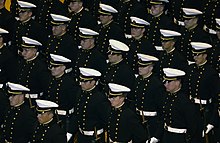
USNA Midshipmen in parade clothes (2003)
Naval Academy midshipmen, in improver to standard Navy officer uniforms, also wear parade dress of traditional 19th-century military cutting, waist-length tunics with stand collars and double rows of gold buttons.[44]
Prisoners [edit]
Prisoners in the custody of Navy shore correctional facilities are required to wearable a special uniform, instead of their regular working compatible. All prisoners, regardless of their military branch habiliment the same compatible, with a nighttime blue variant for pre-trial confinement and a khaki one for post-trial confinement.[45]
Obsolete uniforms [edit]
NWU Type I [edit]

A male navy officer wearing the NWU Type I (2008); the uniform was retired in 2019.
Introduced in 2008, the Navy Working Uniform in blue and gray pixelated cover-up was only in service until 2019, having already been banned from shipboard use when information technology was plant not to exist flame-retardant. It had been field of study to mockery both inside and outside the Navy, as "Aquaflage" and "Battle Wearing apparel Oceanic," and pointed questions most the utility of camouflage for ships' crews.[46] The tan and dark-green Blazon II and Iii remain in service, for Navy personnel ashore.
Aviation Working Khaki [edit]
Navy Uniform Regulations Modify No. eleven issued 22 June 1917 authorized naval aviators to wear a summertime service flying compatible of Marine Corps khaki of the same design as the officers' service dress white uniform tunic and trousers. It was to be worn with high, laced tan leather shoes simply "when on immediate and active duty with aircraft", and might be worn under similarly colored moleskin or khaki sail coveralls as a "working dress" uniform.[47]
Naval aviators typically flew patrol bombers from shore bases until the first United States aircraft carrier USSLangley was commissioned on twenty March 1922. Differing uniforms afloat precipitated a 13 October 1922 Bureau of Navigation letter: "Uniforms for aviation will be the same every bit for other naval officers, doing away with the green and khaki, which may exist worn until June 1, 1923, just only at air stations." Khaki aviation uniforms of a somewhat different design were reinstated on 8 Apr 1925.[47]
Service Clothes Khaki [edit]

Two naval officers showcase the at present-discontinued service wearing apparel khaki uniform in September 2007.
During World War II, a single-breasted heavy cotton twill jacket with shoulder boards was worn with cotton twill trousers over a long-sleeved cotton fiber shirt with a black tie as "Service Dress Khaki", allowing cleaning in shipboard laundry facilities. Later on, through the Vietnam State of war, the trousers and jacket were often fabricated of calorie-free wool or wool-blend fabric equally routine access to dry out-cleaning facilities became available. The uniform was dropped in 1975 past then-Principal of Naval Operations, Admiral James Holloway, in gild to reduce the number of items in the officer'south seabag. A revived version of the compatible was appear in 2006 on a test ground. In 2008 it was authorized for wearable by deputed officers and CPOs during the summer months and in tropical climates.[48] The uniform reintroduced a khaki service glaze worn with a blackness tie and shoulder boards. Information technology was intended to provide a more practical alternative to the Service Dress Whites and a more formal alternative to the Service Khakis. This uniform was frequently worn in public past Adm. Mike Mullen during his time as Chief of Naval Operations and Chairman of the Joint Chiefs of Staff; Mullen was seen wearing this uniform with the jacket removed in the photograph in the White House State of affairs Room during the Navy SEAL raid on Osama bin Laden'south chemical compound. In October 2012, price considerations led to the cancellation of the full-scale reintroduction of the uniform, and the uniform was dropped from the Navy.[49] [50]
Service Dress Bluish Yankee [edit]

U.S. Navy Uniform: Service dress blue Yankee, male person Navy officers, 1983.
The rarely seen Service Dress Bluish Yankee uniform replaced the dark trousers and black shoes of Service Dress Blue with white trousers and shoes from the white uniform. Prescribed for officers.[51]
Wintertime Blueish [edit]
The Winter Blueish uniform was authorized for all ranks. Due to its about-blackness color, it was called the "Johnny Greenbacks" uniform (a reference to the song/album Man in Black by the singer of the aforementioned name).[52] [53] It was a long sleeve blackness button-up shirt and black belt and trousers (optional brim for females), with the headgear either the combination encompass (all Due east-seven and higher up, female E-6s and below) or white Dixie Cup (male person E-6s and below). Garrison caps were an optional secondary headgear, immune to be worn for all ranks.[54] [55]
Equally a service uniform, ribbons and badges were worn, and officers and main petty officers wore metallic collar insignia, while enlisted E-vi and below wore simply the rating badge on the left arm. All men wore ties, females necktabs, with an optional silver clip for sailors at the charge per unit of petty officeholder commencement grade and below, others a gilt clip. The Working Blueish variant omitted the necktie and ribbons.
Working Khaki [edit]
The Working Khaki uniform was worn by officers and chief petty officers, primarily aboard ship or in selected working areas at bases ashore. Originally it was only the Service Dress Khaki uniform worn without the coat and tie. Similar to, but less formal than, the Service Khaki, it consisted of a short or long-sleeve khaki compatible shirt, with warfare insignia and badges (i.e. control pins, nametags, etc., just no ribbons) worn on the tiptop of the left pocket, and pin-on metal rank devices located on the collar. It also came with a set of khaki trousers, a khaki chugalug with a golden belt buckle, a command or "U.South. Navy" ballcap (garrison cap optional), and black or chocolate-brown low quarter shoes, black or brown boots, or black leather rubber shoes. It was ofttimes referred to equally the "Wash Khaki" compatible, considering it was a 100% cotton uniform that could be laundered but required pressing, differentiating information technology from the Service Khaki made of Certified Navy Twill (CNT) or a poly-wool alloy that is considered acceptable for wearable aground and off base, simply which requires dry-cleaning. At the beginning of January 2011, the working khakis were replaced by the Navy Working Compatible, although the Navy Junior ROTC still uses them as of 2017.[16]
Aviation Working Light-green [edit]
A winter working green uniform for deputed officers and Primary Petty Officers in the Naval Aviation customs was authorized on 7 September 1917 in conjunction with adoption of the naval aviator wings chest insignia. The initial uniform pattern was the same as the officers' service dress white uniform tunic and trousers. Similar the summer khaki uniform, it was to exist worn with high, laced tan leather shoes. Like the aviation khaki uniform, the greenish compatible was temporarily banished during the early years of U.s.a. aircraft carrier operations from 1922 until a modified blueprint was reauthorized in 1925.[56] The last version, discontinued in Jan 2011, was somewhat similar to the Navy's revived Service Wearing apparel Khaki compatible in cut and design and bore additional similarities to the Marine Corps' Service Clothes "Alpha" green uniform. Information technology consisted of a dark-green wool glaze and green wool trousers with bronze buttons and a long-sleeve khaki shirt with black necktie. Rank insignia consisted of black embroidery on sleeves in a style like to the gold sleeve braid for officers, or rating marks and service "hash" marks for Principal Petty Officers, on Service Dress Blue uniforms. Metallic rank insignia was worn concurrently on the collar points of the khaki shirt by line officers and CPOs. For staff corps officers, rank insignia was worn on the right collar point and staff corps insignia on the left collar point (typically Medical Corps for Naval Flight Surgeons, etc.) of the shirt. Warfare insignia and, if applicable, Control at Ocean and/or Command Ashore insignia, were worn on the jacket and optionally on the shirt. Command nametags were also optional on both the blouse and/or shirt. Brown shoes were typically worn, although this transitioned to blackness between 1975 and 1986 when chocolate-brown shoes were discontinued. Following the reinstatement of chocolate-brown shoes in 1986, brown shoes over again became the most mutual footwear. Authorized headgear included a combination cover in green, or a green garrison cover.
During World War 2 and the Korean War, ribbons were also authorized with this uniform, making information technology a de facto "service uniform" or "liberty compatible," authorized for habiliment off base. But by the early 1960s, it had go express to that of a "working uniform" for use on base or aboard ship only. Information technology was infrequently worn, primarily due its expense and its 100% wool fabric that typically made information technology unsuitable exterior of the winter months; in the working environments where AWGs were authorized, aviators typically found working khakis or flight suits more than convenient.
The AWG uniform was formally phased out on i January 2011 along with several other uniforms as office of an extensive U.South. Navy compatible consolidation. The Type I Navy Working Uniform took its place.[57]
Tropical Uniforms [edit]
The rarely seen Tropical White Uniform (also referred to every bit Tropical White Short) was similar to the Summer White Service uniform, except white knee shorts and knee socks were worn. Information technology was colloquially known as the "Captain Steubing" uniform, afterwards the character on The Love Gunkhole TV show. Exceptionally rarely worn, though authorized with this uniform, was a pith helmet, with a Naval Officer'southward insignia at the front end, above the skirt.
Tropical working uniforms existed, only were variations on the working khaki and utility uniforms. Knee shorts and black knee joint socks are worn, forth with short sleeved button-upward shirts.
Summertime White/Blueish ("Salt and Pepper") [edit]
Initially worn by East-6 and below beginning in the mid-1970s with the temporary phaseout (until 1982) of the traditional "crackerjack" uniforms, it was later expanded to include master petty officers and commissioned officers. All-time known by the nickname "salt and peppers," the uniform consisted of a summer white shirt and winter bluish (e.1000. black) trousers for males and summer white blouse and winter bluish trousers or winter blueish brim for females. The uniform was worn with a combination embrace and black shoes. Although naval personnel all the same retained all the components that made up this uniform, its apply was discontinued in 1983. Though the U.S. Navy proper discontinued the uniform in 1983, Navy Junior ROTC units connected to vesture information technology for decades after, until they themselves finally discontinued their usage in June 2010.[58] [59]
Service Clothes Gray [edit]
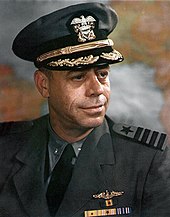
Captain Allan McCann wearing the Service Dress Gray uniform (1944)
This brusque-lived compatible for officers and CPOs was merely authorized from 1943–49, merely was a mutual sight on the E Coast and in the Atlantic/European Theater during World State of war II. It was identical in cut and textile to the Service Wearing apparel Khaki uniform but medium gray in colour with black buttons, worn with a lighter grey shirt and garrison or combination encompass. Officers' shoulder boards were as well grey, with stars/corps insignia and rank stripes in black. "Working grays" were the same uniform worn without the jacket and necktie. The gray uniform was introduced by then-Chief of Naval Operations Ernest King, who idea khaki was more than appropriate to land forces; Admiral Chester W. Nimitz disliked information technology and discouraged its wear in the Pacific Fleet.
CPO Whites [edit]
From 1893 until 1975, master petty officers wore a Service Dress White uniform consisting of white cotton trousers and double-breasted reefer jacket with black necktie. Rating badges and service stripes in blackness were worn on the left sleeve. This uniform was also worn past members of Navy bands regardless of rank. Officer-pattern whites were authorized for CPOs in 1981.
Dungarees [edit]

Freed U.S. POWs in Globe War II-era dungarees (1945)
Dungarees were the junior enlisted (E1-E6) working uniform worn from 1913 through the 1990s; through World War II dungarees with a garrison or combination comprehend were likewise worn past CPOs engaged in muddied jobs. Dissimilar later working uniforms, dungarees were not allowed to be worn outside of military machine installations; service members were allowed to wear the uniform to and from the installation in a vehicle, only were not authorized to make any stops between while in the dungarees. In fact, until World War Ii dungarees could but exist worn in port in ships' interior spaces, below the chief deck or inside gun turrets.[ commendation needed ]
Dungarees consisted of a short or long-sleeve blue chambray shirt, white T-shirt, and bell-bottom denim jeans (the jeans in question had heptagonal "patch" pockets sewn on the front of the pant-legs rather than the traditional "slash" pockets ofttimes seen on noncombatant-worn jeans). Headgear was the white "dixie loving cup" cover for men and an early on form of the black garrison cap or a black beret for women; afterwards graduation from kick military camp, the command ball cap was optional (and in practice more common). Starting in 1995, the white hat was no longer authorized for article of clothing with dungarees, and the command (or Navy) ballcap became the predominant cover. During cold weather a black watch cap was allowed.
The crewman's last name was stenciled in white on the pants just above the back pocket on the correct side. The proper name was besides placed in black on the shirt just above the right breast pocket, normally stenciled on. Names could besides be reinforced with embroidered thread of the appropriate colour on both the pants and shirt. Rate badges (for petty officers) and warfare devices were atomic number 26-on. The charge per unit badges consisted of an all-black eagle (nicknamed a "crow") and chevrons, omitted the rating device found on other enlisted uniforms' rate badges.
Low black leather boots chosen "boondockers" were issued with the dungaree uniform; however, sailors were allowed to wear black leather leap boots. Flight deck personnel were issued a type of taller cap-toe boot similar in design to jump boots known colloquially as "wing walkers". These types of boots had zig-zag patterned out-soles to avoid gathering FOD (Foreign Object Droppings) between the ridges that could litter the flight deck and cause potential damage to aircraft. "Dealer/Chelsea" fashion ankle boots (known colloquially as Lox boots) with elastic-sides were issued to personnel working with Liquid oxygen for easier removal in case the boots would freeze upon contact.
Utilities [edit]

A navy corpsman in 1999 wearing the "dungaree" uniform
The enlisted utilities compatible was worn past junior enlisted sailors, from paygrades E-1 to Due east-6, from the 1990s until 2010, when they were phased out in favor of the NWU. Utilities consisted of dark blue chino cloth trousers with a polyester–cotton alloy shirt, and were considered an updated version of the dungarees compatible of which they shared an artful similarity. Utilities were meant to be worn in a working environs but were authorized to be worn outside military installations, dissimilar coveralls.
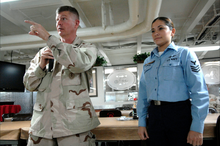
A navy sailor wearing the "utility" compatible in 2009
Commonly sailors wore the command ball cap with this uniform, although a black watch cap was allowed in cold weather; the white "dixie cup" lid was worn for special ceremonies such as the dignified transfer of a decedent. Cloth name tapes were worn similar to that used on utility uniforms of the other services. In 1995 a tape with the words "U.South. NAVY" began being included above the left breast pocket with embroidered enlisted warfare insignia authorized above it, and an embroidered rating badge. The footwear for this uniform was total black, circular-toed boots (referred to equally boondockers), preferably with steel toes. The blue utility jacket was authorized in climates not cold enough as to warrant wearing the black All-Weather Coat.
Enlisted Undress Dejection [edit]
Prior to the introduction of the Winter Blue/Winter Working Blue uniform, personnel Due east-6 and below in office and classroom environments were authorized to vesture the Undress Blue uniform; this broadly resembled the Dress Bluish "crackerjack" uniform just carried no piping or stars, and the sleeves were wide and cuffless like those of the current Dress Whites. Before 1941 this was the standard working uniform for all "above-deck" duties since dungarees were not permitted anywhere the public might run across them. Ribbons and neckerchief were not worn and the uniform was not authorized for liberty.
Enlisted Wearing apparel Whites (prewar) [edit]
Until 1941, the summer and tropical equivalent to the Clothes Blue "crackerjacks" was a white cotton jumper compatible with blue tar flap and cuffs, adorned with white piping and stars like the blueish uniform. This compatible was discontinued "for the duration" and was never reinstated; instead the Undress Whites with the addition of ribbons and neckerchief became the summer clothes compatible for sailors.
The "Flat Chapeau" [edit]

U.S. Navy sailor James R. Ward wearing the Apartment Hat (1940 or 1941)
From 1852 until 1962 (although in practise rarely worn after the middle of Earth War II), enlisted sailors were issued a circular, flat blue wool crewman lid with a ribbon effectually the ring similar to that worn past the Regal Navy. The "Donald Duck" was worn with the Service Dress Bluish uniform on more than formal occasions in lieu of the white "Dixie cup." The ribbon carried the name of the wearer's transport or station embroidered in gilt until 1941, when this was replaced with a generic "U.S. Navy" as a wartime security mensurate.
See also [edit]
- Badges of the United States Navy
- United States Navy officer rank insignia
- List of United States Navy staff corps (insignia)
- List of U.s.a. Navy ratings
- United States Navy enlisted charge per unit insignia
- List of camouflage patterns#Due north America N-Z
- Uniforms of the United States Military machine
- Uniforms of the United States Marine Corps
Notes [edit]
- ^ The Principal of Naval Operations and Commandant of the Marine Corps are heads of separate branches – the connections between the Navy and Marines include that they report to the Secretary of the Navy and they share common legal institutions like Naval Criminal Investigative Service and the Navy-Marine Corps Court of Criminal Appeals.
References [edit]
- ^ Burke, R.P. (January 2017). "NAVADMIN 015/17". Us Navy. Retrieved 3 Apr 2017.
Effective immediately and until further notice, optional wear of male person E7 and above SDB trousers is authorized with the female person SDB uniform. The way of wear of male trousers is per current uniform policy.
- ^ "UNIFORM COMPONENTS". NAVY PERSONNEL COMMAND. US Navy. Retrieved 15 April 2020.
- ^ a b Navy Compatible Matters Office (Baronial 2019). "Summer Compatible Clothing and News" (PDF). UNIFORM NEWSGRAM. Arlington, Virginia: Navy Uniform Matters Office. p. 3. Archived from the original (PDF) on 14 August 2019. Retrieved 14 August 2019.
- ^ Naval Personnel Public Affairs (xviii May 2012). "Navy Announces New Uniform Components, Regulations". Section of the Navy.
- ^ "Archived copy". world wide web.history.navy.mil. Archived from the original on 22 February 2005. Retrieved 12 January 2022.
{{cite spider web}}: CS1 maint: archived copy every bit title (link) - ^ Office of the Chief of Naval Operations (31 July 1972). "Women's New Dress Blues Aren't Blue". OPNAV Information Bulletin. Notes of Involvement. Washington, D.C. 20350: Navy Section. Retrieved 23 November 2015.
{{cite web}}: CS1 maint: location (link) - ^ Worthington, Rogers (5 July 1986). "Saluting A Return To Navy Tradition: To Rebellion And Back In A Decade". Chicago Tribune. Illinois. Retrieved 23 November 2015.
- ^ Chief of Naval Personnel Public Affairs Part (9 October 2015). "Navy Announces Rollout and Article of clothing Dates for Upcoming Uniform Changes". All Hands. United States Section of the Navy. Retrieved 23 November 2015.
- ^ Navy Personnel Command (March 2014). "@USNPeople Compatible Newsgram" (PDF). Navy Uniform Matters Office. United States Department of the Navy. Archived from the original (PDF) on vi February 2015. Retrieved 6 February 2015.
- ^ "White and bluish crackerjacks moving forwards". Navy Times. 20 April 2015.
- ^ "History of United states Navy Uniforms (1776-1981)". The Navy Department Library. 15 June 2006. Archived from the original on three July 2006. Retrieved 3 July 2006.
{{cite web}}: CS1 maint: bot: original URL status unknown (link) - ^ United states of america Navy Uniform Regulations NAVPERS 15665. Accessed ten February 2015.
- ^ a b "A field manual for the Navy Junior Reserve Officers Grooming Corps (NJROTC)". January 2017. Archived from the original on 21 Baronial 2019. Retrieved 25 November 2019.
- ^ "Archived re-create" (PDF). www.public.navy.mil. Archived from the original (PDF) on 18 Baronial 2018. Retrieved 12 January 2022.
{{cite web}}: CS1 maint: archived copy as title (link) - ^ "Military Photos: The New Navy Work Uniform". Strategy Page. StrategyWorld. 4 May 2006. Retrieved 19 Oct 2009.
The color pattern of the NWU (navy blueish, deck gray, brume gray and blackness)
- ^ "Navy Compatible Frequently Asked Questions". New-Navy-Compatible.com. Archived from the original on ten May 2010. Retrieved xix Oct 2009.
- ^ Faram, Mark D (30 October 2008). "Blue cammies coming shortly". Army Times Publishing Company. Archived from the original on 5 November 2009. Retrieved 5 November 2009.
- ^ McCullough, Amy (twenty Jan 2010). "Your thoughts: Navy may try Corps-similar camo". Marine Corps Times. Archived from the original on 12 June 2010. Retrieved 6 May 2010.
- ^ "Navy Working Compatible (NWU) Concepts Frequently Asked Questions". Chore Force Compatible Public Affairs. United states Navy. 13 Jan 2005. Archived from the original on xviii Jan 2005. Retrieved vi May 2010.
- ^ "NAVADMIN 374/09: Navy Working Uniform Type II and Three". Chief of Naval Operations. CDR Salamander. 4 Jan 2010. Retrieved 6 May 2010.
- ^ "Crewman Outcry over Desert Camo Deprival". Navy Times staff. Marine Corps Times. 22 February 2010.
- ^ "Why Is the Marine Corps Fighting With the Navy Over a Camouflage Design?". The Atlantic. 17 Jan 2013. Retrieved 4 October 2014.
- ^ "NWU under fire: Report raises concerns". Retrieved 4 October 2014.
- ^ "Navy Announces Elimination of NWU Type I". v August 2016. Archived from the original on 5 August 2016.
- ^ "The U.Due south. armed services is dumping the dumbest uniform ever". five August 2016. Archived from the original on 5 August 2016.
- ^ "NAVADMIN 17214". Retrieved 12 June 2018.
- ^ Foutch, Michael (2 March 2006). "New Navy Working Uniform and Service Compatible Concepts Approved". Navy News Staff. Retrieved v November 2009.
- ^ US Fleet Forces Public Affairs. "Flame-Resistant Coveralls Coming to the Armada Soon". Us Fleet Forces Command.
- ^ "Navy uniform policy: 14 changes start at present". Navy Times. 7 September 2015.
- ^ "USS Carney Tests Improved Flame-Resistant Variant Coveralls". 7 August 2016. Archived from the original on 7 Baronial 2016.
- ^ "USNSCC Homeport" (PDF). USNSCC Homeport.
- ^ "United states Navy to Test Two-Piece, Flame-Resistant Organizational Habiliment". soldiersystems.net. five March 2019. Retrieved 21 August 2020.
- ^ "Department 3: U.S. Navy Bands". Special Uniform Situations. 5720 Integrity Drive, Millington, Tennessee: Navy Personnel Command. 26 February 2018. Retrieved 7 June 2020.
Enlisted members shall arrange to the designation and composition of uniforms prescribed for chief fiddling officers, Affiliate 3, Department iii, with the exception of service khaki uniform.
{{cite web}}: CS1 maint: location (link) - ^ "Chapter 2 – Grooming Standards", U.Southward. Navy Compatible Regulations, United States Navy, archived from the original on 13 April 2009
- ^ "Archived re-create". www.public.navy.mil. Archived from the original on 17 May 2014.
{{cite web}}: CS1 maint: archived copy as title (link) - ^ "Rainbow Wardrobe". U.Due south. Navy Function of Information. Retrieved 16 May 2007.
- ^ John Pike (six April 2000). "Carrier Design". Globalsecurity.org. Retrieved 13 October 2015.
- ^ "Rainbow wardrobe". Official Website of the United States Navy. Retrieved 26 Apr 2020.
- ^ Chivers, C.J. (25 January 2012), "Potent Sting Is Prepared in the Belly of a Warship", The New York Times, nyt.com, retrieved 26 January 2012,
A version of this commodity appeared in print on January 26, 2012, on page A6 of the New York edition with the headline: Strong Sting Is Prepared In the Belly Of a Warship.
- ^ "Captain and Crew". Naval History. Archived from the original on 1 May 2013.
- ^ "Infantry Dress". US Naval Academy. Retrieved iii Jan 2020.
- ^ "Navy Corrections to Mandate New Uniforms". US Navy. 24 April 2019. Archived from the original on 27 Apr 2019. Retrieved 27 Apr 2019.
- ^ Faram, Marking (22 Baronial 2017). "The U.S. military is dumping the dumbest compatible always". Navy Times.
- ^ a b Van Wyen, Adrian O. (1969). Naval Aviation in World War I. Washington, D.C.: Chief of Naval Operations. pp. 9& 74.
- ^ Courtney Kube (17 July 2008). "New Navy uniform goes retro". MSNBC Digital Network. Archived from the original on 21 July 2008.
- ^ "Navy Announces Service Dress Khaki Cancellation". Military.com. 23 October 2012. Retrieved 10 December 2012.
- ^ "NAVADMIN 314/12". xix October 2012. Retrieved 31 March 2017.
- ^ Service Dress Bluish Yankee for male person Archived 23 April 2009 at the Wayback Machine (archived version) and for female (archived version) officers
- ^ Faram, Marker D (28 March 2005). "New duds for everyone?". Navy Times. Regular army Times Publishing Company. Retrieved sixteen October 2009.
They include service khakis, clearly the nearly used of the trio; summertime whites, featuring white pants and shirts and shoulder boards for officers; and the less-visible winter blues, usually known equally the "Johnny Cash" uniform.
[ permanent dead link ] - ^ Van Avery, Chris (4 October 2004). "The good, bad and ugly of proposed uniforms". Navy Times. Army Times Publishing Visitor. Retrieved 16 October 2009.
Combining a brusk- or long-sleeved white shirt with the blue trousers already in sailors' seabags eliminates the trouble of keeping summertime white trousers white and Johnny Cash shirts unburned by a temperamental iron.
- ^ "U.Due south. Navy Compatible Regulations, Male person Enlisted Winter Blue Uniform". half-dozen October 2006. Archived from the original on six Oct 2006.
{{cite web}}: CS1 maint: bot: original URL status unknown (link) - ^ "U.S. Navy Uniform Regulations, Female Enlisted Winter Blueish Uniform". 20 May 2007. Archived from the original on 20 May 2007.
{{cite web}}: CS1 maint: bot: original URL status unknown (link) - ^ Van Wyen, Adrian O. (1969). Naval Aviation in World War I. Washington, D.C.: Chief of Naval Operations. pp. 33& 74.
- ^ "On This Date in Naval Aviation History: Aviation Greens Brand A Comeback". Naval History Blog. 8 April 2010. Archived from the original on 12 April 2010. Retrieved 12 April 2010.
- ^ Navy Inferior ROTC Cadet Field Transmission (PDF) (8th ed.). Naval Educational activity and Preparation Command. June 2010. Archived from the original on 31 March 2017. Retrieved 31 March 2017.
{{cite book}}: CS1 maint: bot: original URL status unknown (link) - ^ Navy Junior ROTC Cadet Field Manual (6th ed.). Naval Pedagogy and Training Command. August 2005. Archived from the original on 25 Dec 2018. Retrieved 28 December 2018.
Further reading [edit]
- U.Southward. Navy Uniform Regulations (November 2020)
- U.S. Navy Uniform Regulations, Summary of Changes (March 2017)
- Navy Wearable & Textile Update Presented to Joint Advance Planning Cursory for Industry (October 2015)
- U.S. Navy uniform regulations, 2006
- United States Navy Compatible Regulations (Jan 1998)
External links [edit]
- Official website
gustavsonsigne1962.blogspot.com
Source: https://en.wikipedia.org/wiki/Uniforms_of_the_United_States_Navy
0 Response to "I Want to Design a Art for T Shirt Third Second First Class Navy Crow"
Post a Comment